A few minutes after Julian Assange was scandalously arrested and dragged out of the Ecuadorian Embassy in London last week, I was contacted by RT.com to do an interview. While further comments will follow, here are my initial thoughts:
UK and EU Security
A couple of recent interviews about the themes of UK and EU security, going forward.
Europe_and_the_current_security_situation from Annie Machon on Vimeo.
And:
Post_Brexit_UK_EU_Security from Annie Machon on Vimeo.
Attack on Wikileaks threatens press freedom everywhere
My interview on RT.com about yet another attack against Julian Assange, editor in chief of Wikileaks, that threatens press freedom everywhere:
UK sets up yet another costly spy agency
This article was first published on RT Op Ed a month ago.
The UK Ministry of Defence announced on 21 September the establishment of yet another British spy agency, an amalgam of military and security service professionals designed to wage cyber war against terrorists, Russia and organised crime. The new agency will have upwards of 2000 staff (the size MI5 was when I worked there in the 1990s, so not inconsiderable). I have been asked for a number of interviews about this and here are my thoughts in long form.
The UK already has a plethora of spy agencies:
- MI5 – the UK domestic Security Service, largely countering terrorism and espionage;
- MI6 – the Secret Intelligence Service, tasked with gaining intelligence abroad;
- GCHQ – the government electronic surveillance agency and best buds with the US NSA;
- National Cyber Security Centre – an offshoot that protects the UK against cyber attacks, both state and criminal;
- NCA – the National Crime Agency, mainly investigating organised crime;
- not to mention the police and Customs capabilities.
To provide American context, MI6 equates to the CIA, GCHQ and the NCSC equate to the NSA, and the NCA to the FBI. Which rather begs the question of where exactly MI5 fits into the modern scheme – or is it just an anachronistic and undemocratic throw-back, a typically British historical muddle, or perhaps the UK’s very own Stasi?
So why the new and expensive agency at a time of national financial uncertainty?
Of course I acknowledge the fact that the UK deserves to retain a comprehensive and impressive defence capability, provided it is used for that purpose rather than illegal, needless wars based on spurious political reasons that cost innocent lives. Every country has the right and the need to protect itself, and the cybers are the newly-defined battle lines.
Moreover, it might be overly simplistic to suggest that this is just more empire-building on the part of the thrusting and ambitious young Secretary of State for Defence, Gavin Williamson. Perhaps he really does believe that the UK military needs augmenting after years of cuts, as the former Deputy Chairman of the UK Conservative Party and er, well-known military expert, Lord Ashcroft, wrote in the Daily Mail. But why a whole new intelligence agency at huge cost? Surely all the existing agencies should already be able to provide adequate defence?
Additionally, by singling out Russia as the hostile, aggressor state, when for years the West has also been bewailing Chinese/Iranian/North Korean et al hacking, smacks to me of political opportunism in the wake of “Russiagate”, the Skripals, and Russia’s successful intervention in Syria. Those of a cynical bent among us might see this as politically expedient to create the eternal Emmanuel Goldstein enemy to justify the ever-metastasising military-security complex. But, hey, that is a big tranche of the British, and potentially the post-Brexit, British economy.
The UK intelligence agencies are there to protect “national security and the economic well-being of the state”. So I do have some fundamental ethical and security concerns based on recent Western history. If the new organisation is to go on the cyber offensive what, precisely does that mean – war, unforeseen blow back, or what?
If we go by what the USA has been exposed as doing over the last couple of decades, partly from NSA whistleblowers including Bill Binney, Tom Drake and Edward Snowden, and partly from CIA and NSA leaks into the public domain, a cyber offensive capability involves stockpiling zero day hacks, back doors built into the internet monopolies, weaponised malware such as STUXNET (now out there, mutating in the wild), and the egregious breaking of national laws and international protocols.
To discuss these points in reverse order: among so many other revelations, in 2013 Edward Snowden revealed that GCHQ had cracked Belgacom, the Belgian national telecommunications network – that of an ally; he also revealed that the USA had spied on the German Chancellor’s private phone, as well as many other German officials and journalists; that GCHQ had been prostituting itself to the NSA to do dirty work on its behalf in return for $100 million; and that most big internet companies had colluded with allowing the NSA access to their networks via a programme called PRISM. Only last month, the EU also accused the UK of hacking the Brexit negotiations.
Last year Wikileaks reported on the Vault 7 disclosures – a cache of CIA cyber weapons it had been stockpiling. It is worth reading what Wikileaks had to say about this, analysising the full horror of how vulnerable such a stockpile makes “we, the people”, vulnerable to criminal hacking.
Also, two years ago a huge tranche of similarly hoarded NSA weapons was acquired by a criminal organisation called the Shadow Brokers, who initially tried to sell them on the dark web to the highest bidder but then released them into the wild. The catastrophic crash of NHS computers in the UK last year was because one of these cyber weapons, Wannacry, fell into the wrong criminal hands. How much more is out there, available to criminals and terrorists?
The last two examples will, I hope, expose just how vulnerable such caches of cyber weapons and vulnerabilities can be if not properly secured. And, as we have seen, even the most secret of organisations cannot guarantee this. To use the American vernacular, they can come back and bite you in the ass.
And the earlier NSA whistleblowers, including Bill Binney and Tom Drake, exposed just how easy it is for the spooks to manipulate national law to suit their own agenda, with warrant-less wiretapping, breaches of the US constitution, and massive and needless overspend on predatory snooping systems such as TRAILBLAZER.
Indeed, we had the same thing in the UK when Theresa May succeeded in finally ramming through the invidious Investigatory Powers Act (IPA 2016). When she presented it to parliament as Home Secretary, she implied that it was legalising what GCHQ has previously been doing illegally since 2001, and extend their powers to include bulk metadata hacking, bulk data set hacking and bulk hacking of all our computers and phones, all without meaningful government oversight.
Other countries such as Russia and China have passed similar surveillance legislation, claiming as a precedent the UK’s IPA as justification for what are claimed by the West to be egregious privacy crackdowns.
The remit of the UK spooks is to protect “national security” (whatever that means, as we still await a legal definition) and the economic well-being of the state. I have said this many times over the years – the UK intelligence community is already the most legally protected and least accountable of that of any other Western democracy. So, with all these agencies and all these draconian laws already at their disposal, I am somewhat perplexed about the perceived need for yet another costly intelligence organisation to go on the offensive. What do they want? Outright war?
Former MI6 spy v Wikileaks editor: First Amendment Rights
First published on RT Op-Ed on 24 August 2018.
While it is all too easy to become frustrated and annoyed by what passes for news in the legacy media these days, this article in the Daily Mail did arouse my particular ire early one morning – and in this instance no particular blame attaches to the newspaper, it is simply reporting some unpalatable facts.
The gist of it is that former British MI6 intelligence officer and current mercenary spy-for-hire, Christopher Steele, author of the discredited “Dirty Dossier” about Donald Trump, has been accorded First Amendment rights in a court case in the USA.
You might wonder why this article caused me so much spluttering annoyance over my breakfast? Steele’s treatment is in marked contrast to that accorded to Wikileaks publisher and editor in chief, Julian Assange, and the hypocrisy is breathtaking. Allow me to expound.
Christopher Steele is a British intelligence officer of pretty much my vintage. According to what is available publicly, he worked for MI6, the British overseas intelligence gathering agency, for 22 years, serving in Russian in the early 90s and in Paris at the end of that decade – around the time that MI5 whistleblower, David Shayler, was imprisoned in that city pending a failed extradition case to the UK. It is probable that Steele would have been monitoring us then.
After being outed as an MI6 officer in 1999 by his former colleague, Richard Tomlinson, he was pretty much desk-bound in London until he resigned in 2009 to set up, in the inimitable way of so many former spooks, a private consultancy that can provide plausibly deniable services to corporations and perhaps their former employers.
Steele established just such a mercenary spy outfit, Orbis Business Intelligence, with another ex-colleague Chris Burrows in 2009. Orbis made its name in exposing corruption at the heart of FIFA in 2015 and was thereafter approached as an out-sourced partner by Fusion GPS – the company initially hired to dig dirt on presidential candidate Donald Trump in 2016 by one of his Republican rivals and which then went on to dig up dirt on behalf of Hilary Clinton’s DNC.
The result is what has become known as the “Dirty Dossier”, a grubby collection of prurient gossip with no real evidence or properly sourced information. As a former MI6 intelligence officer, Steele should be hanging his head in shame at such a shoddy and embarrassingly half-baked report.
On a slightly tangential note, there has been some speculation, suppressed in the UK at least via the D Notice censorship system, that MI6 agent and Russian traitor Sergei Skripal, the victim of the alleged Novichok poisoning in the UK earlier this year, remained in contact with his handler Pablo Miller, who also is reported to work for Orbis Business Intelligence. If this were indeed the case, then it would be a logical assumption that Orbis, via Miller, might well have used Skripal as one of its “reliable sources” for the Dossier.
Despite all this, Steele has won a legal case in the USA, where he had been sued by three Russian oligarchs who claimed that the Dirty Dossier traduced their reputations. And he won on the basis that his report was protected by First Amendment rights under the constitution of the USA, which guarantees US citizens the right to freedom of expression. Despite the fact that Steele is British:
“But Judge Anthony Epstein disagreed, writing in his judgment that “advocacy on issues of public interest has the capacity to inform public debate, and thereby furthers the purposes of the First Amendment, regardless of the citizenship or residency of the speakers”.”
This is the nub of the issue: Steele, a former official UK intelligence officer and current mercenary spy-for-hire, is granted legal protection by the American courts for digging up and subsequently leaking what appears to be controversial and defamatory information about the current President as well as various Russians, all paid for by Trump’s political opponents. And Steele is given the full protection of the US legal system.
On the other hand we have an award-winning journalist and publisher, Julian Assange, whose organisation Wikileaks has never been found to report anything factually incorrect in over 10 years, being told that if he were to be extradited from his current political asylum in the Ecuadorian embassy in London to face the full wrath of a vengeful American establishment, he is not entitled to claim protection of the First Amendment because his is an Australian citizen not an American.
It has been an open secret for years that the US government has installed a secret Grand Jury in Virginia (the home of the CIA) to investigate Assange and bring him to “justice” for publishing embarrassing US government documents as well as evidence of war crimes. There have been calls from US politicians for the death sentence, life in prison without parole, and even assassination. The US has been scrabbling around for years to try to find any charge it could potentially throw at him – hell, it will probably make up a new law just for him, so desperate as it is to make an example of him.
However, the fake “Russiagate” narrative gave the US deep state an additional spur – against all evidence and Assange’s own statements – it alleges that “Russia” hacked the DNC and Podesta emails and Assange was the conduit to make them public. This is seen as a win-win for the US establishment, apparently if erroneously proving that Russia hacked the US presidential election and confirming that Assange runs an “non-state hostile intelligence agency”, according to current CIA Director, Mike Pompeo
Except he does not. He is an editor running a high-tech publishing outfit that has caused embarrassment to governments and corporations around the world, not just America. If he can be prosecuted for publishing information very much in the public interest, then all the legacy media feeding off the Wikileaks hydrant of information are equally vulnerable.
This being the case, surely he of all people requires the protection of the First Amendment in the USA? Otherwise the concept that free media can hold power to account is surely dead?
Have British Spies been hacking the EU?
First published by Consortium News.
Just after midnight on 16 August I was called by LBC in London for a comment on a breaking story on the front page of The Daily Telegraph about British spies hacking the EU. Even though I had just retired to bed, the story was just too irresistible, but a radio interview is always too short to do justice to such a convoluted tale. Here are some longer thoughts.
For those who cannot get past the Telegraph pay wall, the gist is that that the EU has accused the British intelligence agencies of hacking the EU’s side of the negotiations. Apparently some highly sensitive and negative slides about the British Prime Minister’s plan for Brexit, the Chequers Plan, had landed in the lap of the British government, which then lobbied the EU to suppress publication.
Of course, this could be a genuine leak from the Brussels sieve, as British sources are claiming (well, they would say that, wouldn’t they?). However, it is plausible that this is the work of the spies, either by recruiting a paid-up agent well-placed within the Brussels bureaucracy, or through electronic surveillance.
Before dismissing the latter option as conspiracy theory, the British spies do have form. In the run up to the Iraq war in 2003, the USA and UK were desperate to get a UN Security Council resolution to invade Iraq, thus providing a fig leaf of apparent legitimacy to the illegal war. However, some countries within the UN had their doubts and the USA asked Britain’s listening post, GCHQ, to step up its surveillance game. Forewarned is forearmed in delicate international negotiations.
How do we know this? A brave GCHQ whistleblower called Katherine Gun leaked the information to The Observer. For her pains, she was threatened with prosecution under the draconian terms of the UK’s 1989 Official Secrets Act, and faced two years in prison. The case was only dropped three weeks before her trial was due to begin, partly because of the feared public outcry, but mainly because her lawyers threatened to use the legal defence of “necessity” – a defence won only three years before during the case of MI5 whistleblower, David Shayler. Tangentially, a film is this year being made about Gun’s story.
We also have confirmation from one of the early 2013 Edward Snowden disclosures that GCHQ had hacked its way into the Belgacom network – the national telecommunications supplier in Belgium. Even back then there was an outcry from the EU bodies, worried that the UK (and by extension its closest intelligence buddy the USA), would gain leverage with stolen knowledge.
So, yes, it is perfectly feasible that the UK could have done this, even though it was illegal back in the day. GCHQ’s incestuous relationship with the America’s NSA gives it massively greater capabilities than other European intelligence agencies, and the EU knows this well, which is why is is concerned to retain access to the UK’s defence and security powers post-Brexit, and also why it has jumped to these conclusions about hacking.
But that was then and this is now. On 1st January 2017 the UK government finally signed a law called the Investigatory Powers Act, governing the legal framework for GCHQ to snoop. The IPA gave GCHQ the most draconian and invasive powers of any western democracy. Otherwise known in the British media as the “snoopers’ charter”, it had been defeated in Parliament for years, but Theresa May, then Home Secretary, pushed it through in the teeth of legal and civil society opposition. This year the High Court ordered the UK government to redraft the IPA as it is incompatible with European law.
The IPA legalised what GCHQ had previously been doing illegally post‑9/11, including bulk metadata collection, bulk data hacking, and bulk hacking of electronic devices.
It also notionally gave the government greater oversight of the spies’ actions, but these measures remain weak and offer no protection if the spies choose to keep quiet about what they are doing. So if GCHQ did indeed hack the EU, it is feasible that the Foreign Secretary and the Prime Minister remained ignorant of what was going on, despite being legally required to sign off on such operations. In which case the spies would be running amok.
It is also feasible that they were indeed fully briefed and an argument could be made that they would be correct to do so. GCHQ and the other spy agencies are required to protect “national security and the economic well-being” of Great Britain, and I can certainly see a strong argument could be made that they were doing precisely that, provided they had prior written permission for such a sensitive operation, if they tried to get advance intelligence about the EU’s Brexit strategy.
This argument becomes even more powerful when you consider the problems around the fraught issue of the border between Northern Ireland and Ireland, an issue about which the EU is being particularly intransigent. If a deal is not made then the 1998 Good Friday Agreement could be under threat and civil war might again break out in Northern Ireland. You cannot get much more “national security” than that and GCHQ would be justified in this work, provided it has acquired the necessary legal sign-offs from its political masters.
However, these arguments will do nothing to appease the enraged EU officials. No doubt the UK government will continue to state that this was a leak from a Brussels insider and oil will, publicly at least, be seen to have been poured on troubled diplomatic waters.
However, behind the scenes this will multiply the mutual suspicion,and will no doubt unleash a witch hunt through the corridors of EU power, with top civil servant Martin Selmayr (aka The Monster) cast as Witchfinder General. With him on your heels, you would have to be a very brave leaker, whistleblower, or even paid-up agent working for the Brits to take such a risk.
So, perhaps this is indeed a GCHQ hack. However justifiable this might be under the legally nebulous concept of “national security”, this will poison further the already toxic Brexit negotiations. As Angela Merkal famously if disengenously said after the Snowden revelation that the USA had hacked her mobile phone: “no spying among friends”. But perhaps this is an outdated concept – nor has the EU exactly been entirely friendly to Brexit Britain.
I am just waiting for the first hysterical claim that it was the Russians instead or, failing them, former Trump strategist-in-chief, Steve Bannon, reportedly currently on a mission to build a divisive Alt-Right Movement across Europe…..
Whistleblowers — RT Interview
In the wake of another apparently victimised whistleblower emerging from the US intelligence community, here is an interview on the subject on RT:
Living in a World Bereft of Privacy
First Published by Consortiumnews.com.
A few days ago I first received a menacing message from someone calling herself Susana Peritz, telling me that “she” had hacked my email, planted malware on my computer, and had then filmed me getting my jollies while watching “interesting” porn online. Her email had caught my attention because it had written in the subject line a very old password, attached to a very old email address I had not used for over a decade, and the malware must have been planted on a defunct computer.
Putting aside the fact that I am far more concerned about GCHQ or the NSA hacking my computer (as should we all be), this did rather amuse me.
Apparently, I must pay this “Susana” $1000 via Bitcoin or, shock, have my alleged pleasures shared with my acquaintances. And just last night I received another courteous request for cash from someone calling themselves Jillie Abdulrazak, but the price has now inflated to $3000.
Why am I not concerned? Well, I can safely say — hand on heart — that I have never watched online porn. But this got me thinking about how or why I could have been singled out for this mark of a blackmailer’s esteem, and that brings me on to some rather dark thoughts.
It is perfectly possible that a rare, unguarded moment of long-distance online love might have been captured (but by whom?). That would probably be over a decade ago and would certainly have been using the old email account which was attached to the particular password at the time.
However, even those memories have been denied me – I distinctly remember that I have been too paranoid for too long and have always covered the built-in computer camera lens. Anything that could possibly have been recorded could only be audio – a saucy phone call at most. There can be no video of my younger self, alas.
I have had good reason to be paranoid. In the late 1990s I supported my former partner and fellow MI5 intelligence officer, David Shalyer, in his whistleblower exploits to expose the crimes and incompetence of the UK spy agencies at the time.
This resulted in us literally going on the run across Europe, living in hiding for a year in la France profonde, and another two years in exile in Paris before he voluntarily returned to the UK in 2000 to face the music and inevitably, under the terms of the UK’ draconian 1989 Official Secrets Act, being sent to prison for exposing the crimes of British spies.From those years, knowing what we knew about the spies’ capabilities even then, the sense of being always potentially watched has never rubbed off.
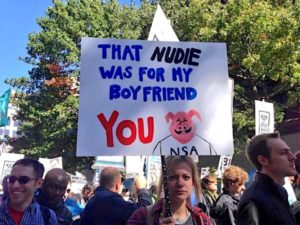 So, knowing absolutely that I have never watched any online porn and that I always keep my computer camera lens covered, “Susana” and “Jillie” can go whistle. You have tried to shake down the wrong paranoid ex-MI5 whistleblower, darlings. And my tech people are now hunting you.
Any possible audio could, I suppose, be spliced in some way to some dodgy video to make this the stuff of a blackmailer’s dreams. That, surely, will be easy to forensicate – and indeed I have other friends who can do this, at world class level.
Alternatively, the former love at the time could have recorded the audio for his own nefarious personal usage for some nebulous time in the future. And if that future is now, after he had shown himself a long time ago to be chronically dishonest, why do this in 2018 when we have been separated for years?
Or indeed, he may have continued to used the old email account himself to watch vile material – he certainly had the password back then and perhaps he uses it to distance himself from his own porn habit (fapware, as the geeks call it)? If that is the case, he is even less honourable than I had considered him to be.
Or perhaps this is some type of dark LoveInt operation by the spooks, in some failed attempt to frighten or embarrass me?
But there is, of course, a bigger, more political picture.
Ever since I worked as an intelligence officer for MI5, before going on the run with David Shayler during the whistleblowing years in the late 1990s, I have been painfully aware of the tech capabilities of the spies. Even back then we knew that computers could be captured by adversaries and turned against you – keystroke loggers, remote recording via microphones, cameras switched on to watch you, and many other horrors.
The whistleblowing of Edward Snowden back in 2013 has confirmed all this and more on an industrial, global scale – we are all potentially at risk of this particular invasion of our personal privacy. I have kept my computer and mobile camera lenses covered for all these years precisely because of this threat.
One specific Snowden disclosure, which has received little MSM traction, was a programme called OPTIC NERVE. This was a GCHQ programme (funded by American money) that allowed the spooks to intercept in real time video conferencing calls. It turned out, horror, that 10% of them were of a salacious nature, and the spooks were shocked!
I have spoken about privacy and surveillance at conferences around the world and have many, many times had to debate the supposition that “if you are doing nothing wrong, you have nothing to hide”.
However, most people would like to keep their intimate relationships private. In this era of work travel and long distance relationships, more of us might well have intimate conversations and even video play via the internet. In an adult, consensual and mutually pleasurable context, we are doing nothing wrong and we have nothing to hide, but we surely don’t want the spooks to be watching us or listening in, any more than we would want the criminals capturing images and trying to shake us down for money.
This low-level and amateur attempt at extortion is risible. Unfortunately, the threat from our governments spying on us all is not.
Assange under increased threat
Speculation has been rife over the last couple of weeks that Julian Assange may be handed over to the British by a new and pusillanimous Ecuadorian government, thereby breaching its pledge to grant Assange political asylum and the protection due to a citizen of Ecuador. Here’s my take:
Ecuador President threatening the political asylum of Assange from Annie Machon on Vimeo.
Facebook snooping on Russians
Here is an interview I gave to RT about the recent news that Facebook has tagged 65,000 Russians as interested in “treason”. Hardly helpful, but similar to the other snooping with algorithms they have done across the West into people’s supposed views, and not least the involvement with Cambridge Analytica.
Facebook implicated in more surveillance from Annie Machon on Vimeo.
Britain’s Brave New World just got Braver
First published by Consortium News.
On 5th June 2018 the UK Home Secretary, Sajid Javid, unveiled his new counter-terrorism initiative that he says is targeting an ever-metastasising threat, yet it raises a raft of new questions about people’s rights.
The government is acting on the imperative that something needs to be done. But MI5 — officially known as the UK domestic Security Service and the lead organisation in combating terrorism within the UK — has already, since the start of the war on terror, doubled in size and has also been promised yet more staff over the next two years.
Yet despite these boosted resources for MI5, as well as increased funding and surveillance powers for the entire UK intelligence community, virtually every terror attack carried out in the UK over the last few years has been committed by someone already known to the authorities. Indeed, the Manchester bomber, Salman Abedi, had been aggressively investigated but MI5 ignored vital intelligence and closed down the active investigation shortly before he carried out the attack.
This failure to target known threats is not just a UK problem. Attacks across Europe over the last few years have repeatedly been carried out by people already on the local security radar.
New approaches are needed. But this latest offering appears to be a medley of already failed initiatives and more worryingly a potentially dangerous blueprint for a techno-Stasi state.
The main points of the new Home Office plan include: making MI5 share intelligence on 20,000 “subjects of concern” with a wide range of organisations, including local councils, corporations, local police, social workers, and teachers; calling on internet companies to detect and eradicate extremist or suspicious content; making online marketplaces such as Amazon and eBay report suspicious purchases; increasing surveillance of big events and infrastructure; and passing even tougher anti-terrorism laws.
This all sounds reasonable to those who are fearful of random attacks on the streets or at events – that is unless one has seen in the past how some initiatives have already been proven to fail or can foresee in the future wholesale abuse of increased surveillance powers.
Intelligence is not Evidence
The most chilling part of the MI5 plan is sharing intelligence on 20,000 subjects of concern. First of all, this is intelligence – by nature gathered from a range of secret sources that MI5 would normally wish to protect. When communicating with counter-terrorism police, intelligence agencies will normally hide the source, but that will require an immense amount of work for 20,000 cases before the information can be shared. Secondly, bear in mind that intelligence is not evidence. Effectively MI5 will be circulating partially assessed suspicions, perhaps even rumours, about individuals, very widely about people who cannot be charged with any crime but who will fall under a deep shadow of suspicion within their communities.
Also if this intelligence is spread as widely as is currently being suggested, it will land in the laps of thousands of public bodies – for instance, schools, councils, social care organisations, and local police. Multiple problems could arise from this. There will no doubt be leaks and gossip within communities – so-and-so is being watched by MI5 and so on.
There will also be the inevitable mission-creep and abuse of power that we saw almost 20 years ago when a whole range of the same public bodies were allowed access to the new eavesdropping and surveillance law, the Regulation of Investigatory Powers Act (2000). Back then, local councils were abusing counter-terrorism legislation to catch people who might be trying to play school catchment areas (districts) to get their children into better schools, or even, and I kid you not, might be cockle-rustling on their local beach. Of course, such intrusive electronic surveillance powers have been significantly increased since then, with the Investigatory Powers Act 2017, that allows bulk storage, bulk dataset hacking and hacking per se.
All this follows the notorious Home Office counter-terrorism PREVENT scheme – the failed parent of these new proposals.
A decade ago PREVENT was designed to reach out, build bridges with Muslim communities across Britain, encouraging them to report any suspicious behaviour to the authorities to nip incipient radicalisation in the bud. Unfortunately it did not quite work out that way. Young Muslims told stories of pressure from MI5 to spy on their communities. It destroyed community trust rather than built it.
Unfortunately, this new Home Office scheme goes even further down the wrong path. It asks teachers, social workers, the local police and other authority figures to go beyond reporting suspicious behaviour to actually be given a list of names to keep a awatch on “subjects of interest”.
The last time such a system of community informants used in Europe was ended when the Berlin Wall came down in 1989 and East Germany’s Stasi system of a vast network of informers was revealed in all its horror. How ironic that the same system that was devised to protect the East German youth from the “decadent influence” of Western ideals is now being proposed in a “decadent” Western country to spy on its own youth for traces of radicalisation.
Corporate Allies
Suffice to say that if the British government cannot even make the internet titans such as Google and Facebook pay their fair share in taxes, nor call Facebook’s Mark Zuckerberg to account in Parliament about the Cambridge Analytica scandal, then good luck forcing them make a meaningful effort to root out extremist material.
But even if they do agree, this idea is fraught with the troublesome question of who gets to decide whether something is extremist material or a dissenting opinion against the establishment? Facebook, Google and Youtube are already engaging in what can only be called censorship by de-ranking in search results material from legitimate dissident websites that they, with no history of exercising news judgement, deem “fake news”.Such established news sites such as Wikileaks, ConsortiumNews and World Socialist Web Site as well as many others listed on the notorious and unreliable PropOrNot list have taken a significant hit since these restrictions came into play on 23 April 2017.
Amazon, eBay and other retail companies are being asked to report suspicious sales of precursor materials for bombs and other weapons. Car hire companies will be asked to report suspicious individuals hiring cars and lorries. Algorithms to detect weapons purchases may be feasible, but denying rentals to merely “suspicious” individuals who’ve committed no crimes strays into Stasi territory.
Back in the era of fertiliser lorry and nail bombs, laws were put in place across Europe to require fertiliser companies to report strange purchases – from people who were not registered agriculturalists, for example, Unfortunately, this law was easily subverted by Norwegian right-wing terrorist, Anders Breivik, who simply worked to establish a farm and then legally purchased the ingredients for his Oslo car bomb in 2011.
You are Being Watched
The UK is known as having the most CCTV cameras per capita in the Western world. There have been various plans mooted (some leaked to Wikileaks) to hook these up to corporations such as Facebook for immediate face tagging capabilities, and the development of algorithms that can identify suspicious behaviour in real time and the police can move to intercept the “suspect”.
Face recognition cameras are being trialled by three police forces in the UK – with software that can allegedly watch crowds at events and in stations and potentially identify known criminals and suspects in a crowd and alert the police who will immediately move in and intercept.
Unfortunately, according to Big Brother Watch in the UK, these computer systems have up to a 98% failure rate. If the Home Secretary is really suggesting that such dodgy software is going to be used to police our public spaces I would suggest that he ask his geeks to go back and do their homework.
Do we really want to live in a country where our every movement is watched by technology, with the police waiting to pounce; a country where if we are running late or are having a stressed work day and seem “strange” to a person in a car hire company, we can be tracked as a potential terrorist; where children need to fear that if they ask awkward, if interested, questions of their teachers or raise family concerns with social care, they might already be on a watch list and their file is stacking up slowly in the shadows?
That way lies totalitariansim. I have been tracking how a state can slide unthinkingly into such a situation for years, particularly looking at such warnings from history as 1930s Germany and, over the last decade, I have seriously begun to fear for my country.
If these measures go through Britons could be living under SS-GB – the name of a book by the excellent spy writer, Len Deighton, in his envisioning of what the UK would have been like if the Nazis had succeed in invading during World War Two. The ultimate irony is that the acronym attributed to MI5 at international intelligence conferences way back in the 1990s used to be UK SS – UK Security Service. I hear it has changed now….
A Tale of Two Tortures
First published by Consortiumnews.com.
It was with some disbelief that I read of two torture-related stories emerging around the same time last week. The first was about the legal victory of Abdul Hakim Belhaj, Libyan dissident, kidnap victim of MI6 and the CIA, and torture victim of Colonel Gaddafi. UK governmental apologies were finally made and reparation paid. For once justice was seen to be done and the use of torture condemned.
Meanwhile, across the pond last week the reverse side of the same coin was on full disgusting display. Our American chums are in the process of attempting to appoint an alleged notorious torturer as the head of the CIA.
While nominee Gina Haspel had soft-ball questions lobbed at her by a tame pack of senators at her confirmation hearing, retired CIA senior analyst, former presidential briefer, and now justice activist, Ray McGovern, who stood up and said what the Senators knew, but would not say; namely that she supervised — directly, on site — the waterboarding of Al Nashiri, who had been kidnapped and brought to the first secret CIA prison abroad (in Thailand) for “interrogation.” McGovern was dragged out by four burly police, thrown to the ground, and injured when additional police piled on. Here is a link to the video of this assault.
By juxtaposing these two incidents I am not trying to make the point that the UK is morally better than the USA when it comes to torture over the last 17 years – manifestly it has not been – but certainly in the time I served in MI5 in the 1990s the use of torture was verboten. Partly for ethical reasons, but mainly because the British Deep State had learned to its cost how counter-productive the use of torture and illegal imprisonment could be during the early stages of the bitter civil war in Northern Ireland in the 1970s.
Unfortunately those hard-won lessons were generational, and that peer group began to retire in the late 1990s. As a result, come the aftermath of 9/11, when the USA lurched down a path of harsh military retaliation, illegal war, kidnapping and torture, the compliant British intelligence agencies followed helter-skelter down the same path, all in the name of the special intelligence relationship.
So, back to the Belhaj case. To get to the root of this I shall need to transport you back to 1995. Although the US-funded Mujahideen in Afghanistan was by then morphing into Al Qaeda and had just about hit the radar of MI5 as an emergent, if regional threat, peace seemed to be breaking out all over the world: the Cold War was officially over, a peaceful resolution to the civil war in Northern Ireland was in the making, and there even seemed to be some progress with the running political sore that is Palestine and the Israeli occupation, with the Oslo Accords of 1993.
However, Libya – at that time a “rogue” nation – was still on the Western intelligence hit list. Partly because it was suspected by the UK government to have been behind the Lockerbie bombing in 1988 and the search for the perpetrators was a top level priority for MI6 in which it had failed for years to make any progress, and partly because Gaddafi had largely closed the huge Libyan oil reserves to Western oil companies.
So when, in 1995, a Libyan military intelligence officer (subsequently codenamed TUNWORTH) walked into the British embassy in Tunis and asked to speak to the resident spook, MI6 leapt at the chance to get rid of Gaddafi, solve the Lockerbie case, and allow Britain and its allies to once again plunder the vast Libyan oil reserves.
TUNWORTH had a group of “rag-tag Islamist extremists” to carry out this coup attempt, and wanted support and money from MI6, which was quickly offered. The attack was illegal under UK law, which required a ministerial sign-off before such an operation, it went wrong, and it killed innocent people. How much heinous could it get? Here is the full account of this failed coup attempt.
So how does this fit in with Abdul Hakim Belhaj? Well, it turns out he was the co-founder of the Libyan Islamic Fighting Group (LIFG), the very organisation that MI6 had funded for this attack. As a result, he was a wanted man in Libya. And after Gaddafi’s return to the international fold following his notorious deal in the desert with then-UK Prime Minister, Tony Blair, in 2004, Belhaj was the gift from MI6 that sealed the deal.
In 2004 he and his pregnant wife were tracked down and intercepted by MI6 in Kuala Lumpur, Malaysia. They were flown to Bangkok in Thailand and held in a CIA black site, before onward transit to Libya. The flight took 18 hours, and both Belhaj and his pregnant wife were lashed to the floor of a US military transport plan for the duration.
Belhaj was subsequently held in the notorious Abu Selim prison for the next six years where he was repeatedly and hideously tortured. He was finally released under an amnesty brokered by Gaddafi’s son and heir, Saif al-Islam, in 2010.
All that might have been that, except the West made a catastrophic decision to once again try to depose Colonel Gaddafi in 2011. This time the charge was led not by the USA but by France and its President at the time, Nicolas Sarkozy, but ably backed up by the ever-reliable UK and USA, in a “humanitarian intervention” to protect the citizens of Islamist Benghazi – which by the way was not under direct threat at the time. Another fabricated excuse for a Western war of aggression.
(As a side note, Sarkozy is currently under investigation for illegally accepting fifty million euros from Gaddafi to fund his bid for the French Presidency in the 2007 election, and in the same year Gaddafi was awarded a full state visit to France.)
This time the West achieved openly and shamelessly, in the gaze of the world’s media, what they had failed to do shamefully and in secret in 1996: it toppled Gaddafi, who was caught, brutalised and buggered with a bayonet, murdered, and his mutilated corpse left on display for days. His son, Saif al-Islam was captured, tortured and imprisoned. He is now free and re-entering the political fray in Libya.
In the chaos that followed the overthrow of Gaddafi, Human Rights Watch staff made it to Libya and found a cache of documents left in the office of notorious intelligence chief, Musa Kusa, who had fled the country initially to the UK and then fled on to Qatar.
Amongst these documents was a letter from the MI6 Head of Counter-Terrorism, Sir Mark Allen, dated from 2004. He had helped facilitate the “deal in the desert”, and wrote a congratulatory letter to Musa Kusa about being able to help facilitate the capture of Belhaj, and effectively to see him as a “gift” to the Libyan régime in 2004, as a gesture of good will. Here is an excerpt from Allen’s letter to Musa Kusa, submitted by Belhaj’s lawyers:
“I congratulate you on the safe arrival of [Mr Belhaj]. This was the least we could do for you and for Libya to demonstrate the remarkable relationship we have built over recent years.….Amusingly, we got a request from the Americans to channel requests for information from [Mr Belhaj] through the Americans. I have no intention of doing any such thing. The intelligence about [Mr Belhaj] was British… I feel I have the right to deal with you direct on this”.
Because of that good will, the Gaddafi régime fatally trusted its new relationship with the West; and a man and his pregnant wife suffered, and the country as a whole continues to suffer immensely from the ensuing civil war that followed Gaddafi’s assassination..
The court case last week in the UK was a victory for them. Belhaj himself, despite successive UK governments offering one million pounds to drop the case, has always stated that he only required £1, plus an acknowledgement and apology from the UK government about what happened to him. This week he finally received it.
For her ordeal, his wife accepted half of the amount offered. The three UK key players – PM Tony Blair, Foreign Secretary Jack Straw, and MI6 Sir Mark Allen naturally have yet again not been called to account. Not a blemish to their reputations….
So are we likely to see the same admission of guilt from the instigators of the US torture programme?
Far from it. Even if the Gina Haspel confirmation hearing in Washington goes against her, the fact she was even considered for the post of heading the CIA is utterly shameless. As was the disgusting treatment of CIA pensioner and peace protester, Ray McGovern.
Discussing the Belhaj Torture Case with George Galloway
I enjoyed my interview on UK Talk Radio with George Galloway this evening about the settlement of the shocking Liyban Belhaj torture case — I have been following this for years and am very glad to see that he finally got justice.
Annie Machon, former MI5 Officer, discusses Belhaj rendition case with George Galloway from Annie Machon on Vimeo.
I have been following the case since it started, as you can see here from my article in 2012. But I do now fear for Iran, after what has happened to Libya and Syria.
Blaming Russia is the Default Electoral Position in the West
Here is an interview I did last night about the Russians “hacking” the UK general election last year, conveniently appearing in The Sunday Times yesterday ahead of the UK local elections.….
Déjà vu UK newspaper claims 2017 elections influenced by…well, you know from Annie Machon on Vimeo.
